Showing posts with label Houston. Show all posts

Monday, July 13, 2015

The Ruth Legacy: Conviction and Sacrifice

After my second daughter was born, I wrote my grandmother Alice to tell her that I had named her Alice Ruth.  She wrote me this letter dated September 7, 1998, one month after she was born.

 The other day I was thinking about this letter and decided to do some investigative research to see just how many Ruth's were on our family tree.  Actually, quite a few.

Ruth #1

Ruth Townsend 1789-?

daughter of my 6th great grandparents, James Townsend and Mary Cook

The earliest Ruth I could find, I don't have much information about--only her birth date.  She was born in South Carolina, and her father died when she was 3.  In his will, she was left the plantation along with her siblings.

Her father was disowned by the Quakers when he fought in the Revolutionary War under Colonel Thomas Brandon.  Although it appears he was reinstated after the war.  Her mother then married Ralph Hunt who also died just a few years later.  It was around this time that the Quakers were looking to move to slave-free states.   Many Quakers left South Carolina and moved to Waynesville, Ohio.  She sold their land and moved to Ohio where she married a Quaker Minister named Joseph Cloud in 1810.

Most likely Ruth raised as a Quaker, remained one if she moved to Ohio with her mother.  I could not find a death date nor a marriage date for Ruth, so she may have died as a young child.

The more I study the Quaker religion, the more I see commonalities with the LDS faith.  While our beliefs are not exactly the same, we have experienced the same desire for religious freedom.  The more I learn about my Quaker heritage, the more I appreciate all that they sacrificed.  I'm proud to descend from Quakers.

Ruth #2

Ruth Riding Bagshaw 1877-1930

daughter of my 3rd great grandparents, Christopher Lister Riding and Eliza Adelaide Dolbel


Thanks to familysearch.org, I was able to get this picture and the following information about my 2nd great grandmother's sister, Ruth.

She had a beautiful voice and played the guitar—she was so kind and a great seamstress, and a great gardener
• She had poor health due to a heart condition and was often bedridden and as a result many of the chores fell to the children
• Her husband was a mason in the mines and was often gone for weeks at a time
• She was married in the temple and they had kneeling prayer at every meal

Born and died in St. George.  Baptized in the St. George temple. Married to Robert William Bagshaw for 35 years.  


Ruth's sister Christiana Riding Asay had a daughter named Ruth...

Ruth #3

Ruth Asay Tebbs 1884-1972

daughter of my 2nd great grandparents, Edwin Asay and Christiana Dolbel Riding

Isn't this a beautiful picture of Ruth Asay Tebbs? 
 Fortunately, Ruth was a great writer.  The following information I got from her biography. 

Ruth's father died 10 days before she was born.  Her 27-year-old mother was left to raise five kids on her own.  She decided to move back to Utah and asked her brother George to come down to help move the family.  She gave George the honor of naming her newest baby.  He chose his sister's name, Ruth. 

After moving to Utah, her mother married a man who was 33 years her senior.  Ruth called her step-father "Brother Allphin."  He brother Albert died when she was 8.  

When she was 13, she got a job tending a little boy named Chauncey Steiner.  She would take him home with her and tend him for a week at a time.  She grew to love this little boy.  One time Mrs. Steiner took Chauncy to Salt Lake.  Three days later, Ruth received a telegram saying that 3 1/2 year old Chauncy had died of spinal meningitis.  

Years later Fielding Burnes Tebbs took her out for a boat ride and proposed marriage.  He said that if she didn't say yes, he'd tip the boat over.  She would have married him anyway.  

A year later, her first child Fielding Burnes Tebbs, Jr. was born.  By two years old, he could talk and understand everything.  She sent him to the store to buy a comb, not realizing he was probably too young for such an errand.  When he came back with the comb, he asked if he could run more errands.  By age four, he could read as well as any six year old. When Burnes Jr. was five, he died of tonsillitis.

A couple years later, Ruth got severe appendicitis, the same thing that took her father's life.  Fortunately, an operation was able to save her life. 

Years later, Ruth Tebbs had her sixth child.  A girl whom she named Ruth.    


Ruth #4

Ruth Tebbs Butterfield 1919-2000

cousin to my grandmother, Alice Houston Rasmussen


When Ruth Tebbs married VeLoy Hansen Butterfield, her father asked what she would like as a wedding present.  She said, "For you and Mama to go to the temple with us."  This may not have seemed like a big request, except that her parents had never been sealed in the temple for Burnes, Sr. was not active in the LDS Church.

He replied, "We will."  He then worked on quitting smoking, getting a recommend, and were sealed on Ruth's wedding day.  The following day, Ruth was able to be sealed to her parents, and her husband VeLoy was proxy for little Burnes, Jr. who had died at the age of five.

[Note: Ruth also had a daughter whose middle name is Ruth.]

Ruth #5

Ruth Houston 1903-1910

sister to my grandmother, Alice Houston Rasmussen

My mother's aunt was also named Ruth.  Sadly, my mother never got to know her because Aunt Ruth died one day shy of her 7th birthday.

To read the heart-wrenching story of her and her brother's deaths click here.  

Ruth #6

Ruth Rasmussen 1945-2015

my mother


My mother passed away this past February when she was 68.  She spent the first 53 years of her life always on the go.  Then her feet were crippled and she spent the last 15 years learning how to serve in other ways.  She died quietly and gracefully just a few hours after getting her temple recommend.  

To read stories about my mother's life, click here. 


Ruth #7

Heather Ruth Pack (1969-living)

me

Hey kids!  This is to be my obituary picture.


I have always loved my middle name.  There was a time when I wanted to be called Ruth, but because it was my mother's name I was afraid it would be too confusing.  

As a prolific writer, I have way too many stories to share in this post.  Hop over to my own personal history blog to learn a little more about me.  


Ruth #8

Alice Ruth Petranilla Pack (living)

my daughter


 I think all the other Ruth's would be proud she bears their name.  My mom loved to call her "Allie Ruth."

She is clever, smart, witty, and hilarious.  She loves to read books, visit museums, and watch Audrey Hepburn movies.  She has travelled to several countries and hopes to be an astrophysicist someday.  She's a powerful introvert although some mistake her for being shy--which she's not.

Often I marvel that she is my daughter, in many ways we are nothing alike.  But our common middle name bonds us to the Ruth legacy.


I can't end this post without honoring the first Ruth where the name began.


This picture of Ruth by Sandra Rast hangs in our family room
She is the only female to have a book in the Bible named after her.  You can read her story by clicking here.  

For me, the story of Ruth teaches conviction and sacrifice.  As I look at the lives of the Ruth's who have gone before me, I see that is the common thread.  These are women who had strong convictions and were willing to make sacrifices.  I hope the name continues to live on in our family tree, but more importantly I hope their examples and stories never fade.

Friday, May 23, 2014

Robbing Hermits, Watching Lava Dirt Sunsets, Shooting Antelope, and Other Labor Day Misadventures


Alice Houston Rasmussen (1913-2001)

My grandmother

me-->Ruth Rasmussen Buchanan-->Alice Houston Rasmussen

I found this story written by my grandmother in a box of papers.  My mother read it to me and we laughed so hard that I knew I couldn't change a single word*.

"To the majority of people in our community Labor Day means congregating in Price or Helper and watching a band and assorted sizes of members of United Mine Workers of America parade down Main Street.

To the eccentric group of people known as rockhounds this two-day holiday gives them an excuse to beg and bribe their wives and kids out on one more overnight rock trip before school starts.

The Castle Valley club had made detailed plans to go to the Henry Mts. to get some more of "that wonderful wood" that they have so much of already that they have to pile it on rose bushes in the back yard.  I begged out of it four years ago and haven't heard the last of it.  Maybe it might be fun to camp down on Hansen Creek (goodness knows there had never been a creek before on a rock hunt) and it might be fun to see Bullfrog and Eggnog so I resolved that "come hell or high water" I would be a dutiful wife and go.

I'm not sure about the hell but the high water we got.  The summer drought came to an abrupt halt and it began to rain.  Friday night Wayne, the field trip chairman, decided it wasn't going to stop and the trip was cancelled.  Funny thing about that, too.  When he got us all talked out of it, he and Edith went down there anyway.

Oh, happy day!  Now we could stay home and watch Local 248 run three-legged races in the city park and take it easy before the busy days ahead canning and school routine.  My optimistic thoughts were shortlived and I should have known better than to think that Art Rasmussen, the village playboy, would ever stay home even if he had to go out in a storm and get stranded and get his wife, friends and any able-bodied citizen out of their warm beds to rescue him.  But that is another story.


It seems that this simple minded husband of mine had bought an antelope license while on a jade hunt in Wyoming.  If he couldn't impress me with the second jade hunt in September, he could always pull the punch that he had spent $25 on a license and couldn't let it go to waste. 

Now a nice piece of apple green jade I can see but anytime an antelope is worth two days of my life, the price of two motels and a $25 right to shoot him, we need our heads examined.  I'd rather stay home and eat one of Wayne's billy goats.  Art touched my gullible spot, however when he said he would take me up to South Pass City and see if the two old hermits with all the purple glass had died and maybe had left all those pretty lamps, vases, chandeliers etc. lying around just waiting for me to make off with them.


When I want to arise early to take me to Salt Lake, he is just too sleepy but the morning we left he got me up at 1:30 a.m.  It rained all the way to Vernal and I didn't utter a word until we got to the Flaming Gorge Dam turnoff.   The sign said 2 miles to Dutch John and the damn [I'm not sure if this is a typo or not. Ha! Ha!]  As Art gave no indication of turning, I observed that if he could go 500 miles for an antelope, he could take me 2 miles to see the dam.  He had to admit that it was worth the five minutes it took.

We met our friends Howard and Dora Hanks at Rock Springs and after drinking five cups of coffee apiece and arguing whether to look for Eden Valley wood, turritella agate or jade on the way to antelope area, we proceeded on our way.  We tried to follow some directions scratched on a scrap of paper by a fellow in Helper who knew "just where the prettiest wood you ever saw" was.  About noon we gave up when we came to the conclusion that the guy was mixed up 100% in his directions. 

It began to snow so hard we couldn't see to drive so Art said we would go over to South Pass and visit the burial grounds of our stingy hermits.  Smoke was poring out of the chimney of their little house and it was not ghosts but two very healthy hermits who greeted us and invited us in out of the weather.   When we inquired about the glass they pointed to an old shed outside and said, "There it is under the snow."  Our mutual thoughts of sneaking a piece or two were quickly spoiled when we observed barbed wire around the roof where the glass was.  They very cheerfully took us out to an old dugout and there we saw the most beautiful specimens of wood that we'd ever seen but like the glass, they refused to sell any.  The dumps of the old ghost town had been gleaned by many before us so we found not one piece of junk to take with us.  That ended our adventures that day.

The next day the mighty hunters were out bright and early.  The road we followed was the boundary line and all the does were on our side and the bucks on the other side.  At first it was sorta fun spotting a group of antelope and then driving the jeep like crazy only to have them disappear just as we were ready to shoot.  We were having the sport of hunting but at this rate we wouldn't have any of the distasteful stuff to take home.  I finally realized that it wasn't going to be that easy for Arthur had no intention of going home without his prize and we wouldn't settle for a doe.  By six that evening I was secretly praying that a big buck would stand still long enough for us to shoot him.  My prayers were answered finally and we dressed the critter about sundown.


As we travelled toward the main highway we saw dozens of antelope within shooting distance of the road.  I didn't help matters any by suggesting that we should have hunted jade all day and picked us off a four point buck that evening.

We were now homeward bound and I felt lighthearted so I looked for something congenial to say and commented on the beautiful Wyoming sunset.  Art had suffered all day from a head cold, but he replied that it looked pretty lava dirt to him.  I indignantly asked him what made him think that it was lava dirt.  Wasn't I the one who got the last A in geology?  Since when did a brilliant sunset indicate lava dirt?  Had Don Burge told us this and I was too stupid to remember it?  I demanded an answer and poor Art looked beside himself with bewilderment.

Then he answered, "No one had to tell me.  I have always called a purplish color like that lavender."

Well, we laughed until we were weak and decided that the day hadn't been so bad after all.

The next day was Labor Day and we took our time coming home.  When we got back to Rock Springs we had just missed their parade but we saw plenty of United Mine Workers and felt right
 at home.  Howard drove up to a gas station that didn't use credit cards and we followed suit and when we paid for the gas we had exactly $1 to get home on. It brought back memories of the depression days when we did things on the skin of our teeth.

We rationed ourselves to a plain hamburger and water in Roosevelt and clung tightly to the 50 cents we had left.

The kids were waiting up for their wayward parents and wondered at our sanity when we came in smelling of antelope and told them that we had had a great time.


* Although my grandmother was an amazing writer, she didn't have word processors like we enjoy today so I have fixed her typos and other minor grammatical and spelling errors. 

Tuesday, May 20, 2014

Take Care of the Flowers and Goldfish: A Mother's Letter to Her Daughters

Today I was going through some old boxes and found a photo copy of a letter that my grandmother wrote her daughters Dorothy age 10 and Helen Jean age 5.

DOTTIE READ THIS
4 o'clock in the morning

Dear little girls,

When you wake up Mommee and Daddy will be on their way to Lovell.  Dear Grandma Houston has gone to the Heavenly Father.

Be dear little girls and please keep well.

Dottie, wear your long stockings every day and a hat.
Jeanie, wear your snow pants whenever you go outside.

We will be back in a week.

Bye Bye and lots of hugs and kisses.

Mama and Daddy

Take care of the flowers and gold fish.


This was most likely written around January 7, 1945.  Their other grandmother and neighbor lady probably looked after them.  They wouldn't have been left alone for a week.  


Thursday, May 15, 2014

Family Trails - a Poem by John C. Houston


John Cooper Houston (1876-1960)

My Great Grandfather


me --> Ruth Rasmussen Buchanan --> Alice Houston Rasmussen --> John Cooper Houston 


"Family Trails"

- by John C. Houston, Lovell, Wyoming

Living in the Fatherland long, long ago,
The Assayes joined with the French Huguenot.
The very earliest knowledge, history tells,
Their homes were in the city of Aux-La-Chappells.

If all we've been told is really true,
The Asay name goes back to the year 1422.
Research thru history the fact one gleans,
That our kinship is traced to the Maid of Orleans.

A famous deliverer "Heaven" did send,
The Hundred Years War she brot to an end.
Joan of Arc led the disheartened French,
The war spirit of England she did quench.

The name was spoken by the French Assaye,
An s and the e were dropped at a later day.
Because of war on the Huguenots so much,
They took refuge among the peace loving Dutch.

Spain ruled Holland with an iron hand,
War existed quite universally over the land.
In Western Europe everywhere was strife,
The toll of a Protestant was to pay with his life.

Always at war with the inflooding sea, 
From this enemy the Dutch will never be free-
This warfare has made them determined and brave,
They would turn in the sea their liberty to save.

An early Assaye married a Hollandish dame.
That she was wealthy some people claim.
Philip of Spain in his tyrannical ire,
Burned Dutch cities, their home he did fire.


The Spanish Inquisition drove many away.
The Assayes left Holland early so writers say.
They felt they had stood all they could endure,
Persecuted French yielded to Canada's lure.

In the Eighteenth Century the Asays we find,
Having settled in Acadia with those of their kind.
Thinking the land was owned by the French, 
They raised the French flag and themselves did entrench.

For over a century the French lived in the land.
Prosperity sprang up on every hand.
These people at last a haven had found,
Nothing to annoy them, not even a sound.

It was autumn with in walked, one day - 
At noon time - into the busy village of Grand Pre -
An English officer with papers from the King.
Into the church he was everyone to bring.

Everyone came whether from fields or from loom.
Hastily they filled every inch in that room.
The windows were locked, the door was barred,
While about the building was placed a guard.

There was breathless stillness - not a sound -
Never a person the reason had found.
Now stood before them in haughty mein,
The King's representative, rather tall and lean.

He said that it was his Majesty's decree,
That every Frenchman there should be
Immediately transplanted to other lands.
He was sorry but it was the King's commands.

'Tis sad indeed - the most heartless way,
These innocent people were treated that day.
They were taken direct to the water's deep,
Into row boats they were loaded like sheep.

A boat would move on with load complete.
Families were parted never again to meet.
Some boats sailed one way some another,
Separating children from father and mother.

One boat with rather an interesting fate,
Carried an Asay with his dear mate.
On the Isle of Jersey this boat did land.
The Asays sprang from these parents, grand.

Joseph Asay crossed to New Jersey's shore. 
Two sons they had and possible more.
Isaac at Trenton a gardener became.
Joseph at Camden attained a like fame.

The land was rich, was made by the sea.
For gardening it was as rich as rich could be.
These fore-parents settled here in 1775.
They clustered together like bees in a hive.

It is said that the Asays are of worthy descent,
Industrious, honest, and of well meaning intent.
In those early days valuable land they got,
For to create town sites this land later was bot.

Not all were farmers so we are told,
Some were ministers - Christian teachers bold.
Some had trades - some wealth allowed.
As a family they were said to be rather proud.

Restless youth at length came west.
The first to come, hi faith to attest,
Was our grandfather Joseph and his family, all.
They had gladly heeded the missionary call.

Westward others got the moving craze.
Into many states the trails they did blaze.
Into Illinois Alford moved his worthy dame,
While to Iowa Richard and his wife came.

Out to Colorado moved Sol, Richard's Brother.
While the attractions of South Dakota lured another.
Two Asay brothers established a trading post,
In Nebraska, the state by them liked most.

The Asays are today all over the union.
Our organization hopes to get into communion
With all the branches, scattered everywhere,
And add them to our family tree, now quite bare.

A purpose of this union of Asays here,
To not only unite those living near,
But to include in our great family tree
All of our name, wherever they may be.

And not only the living but also the dead,
We hope to seal to our great family head.
Mortal time will at last be done away,
We will all know each other at some future day.

No one is happy for to live all alone.
When, beyond, at the foot of our Father's throne,
We will join with the family both far and near.
Our joy will be complete in a circle so dear.

It is a call made of one, a call from above,
To search fro the records of those whom we love.
The noblest labor asked of you and me,
Is helping establish one's own family tree. 


Saturday, October 19, 2013

The Empty Flour Barrel

Margaret Crawford Houston (1825-1912)

my third great grandmother


me-->Ruth Rasmussen Buchanan-->Alice Houston Rasmussen-->John Cooper Houston-->James Houston, Jr.-->Margaret Crawford Houston


The white-washed wall wasn't the only miracle Margaret Crawford Houston saw in her lifetime.

After Margaret was baptized into the LDS Church and married James Houston, they came to America to live with the Saints who eventually settled in Utah.

One day Margaret bent over the flour barrel to get some flour out with a pan.

http://www.mutualart.com/Artwork/Young-Woman-and-Barrel-of-Flour/12987986375E79D1


Her husband said, "I saw your stockings when you stooped to get flour from the barrel.  That tells me that it is getting low and we will be needing more."

Margaret retorted, "Well we wouldn't need more if you would stop giving away all the bread I bake.  I baked three loaves yesterday and you gave one loaf to Brother Black because his wife is sick and another to Pete Perkins because his family had gone to bed without supper."


James said, "Brother Brigham told us last night at our Priesthood meeting that if we divided our food with those who did not have any, we would never miss what we gave away.  I promise you, as long as we divide our flour with our friends, flour will always be in the barrel."


"When the flour is gone, it's gone," said Margaret.  "I scraped all there was in the barrel."


Margaret used the last of the flour to make some hot cakes.  She piled them on a plate.


Her daughter Libbie came in.  "Can I have a hot cake?"

"Yes," said Margaret, "but only one.  Father and John haven't had dinner yet."

Libby said, "Oh, maybe I'm not hungry for I had breakfast this morning but Maggie Jones didn't.  Maybe I give this to her if I don't eat it?"
Margaret said, "Yes of course.  Take second one for yourself."

Libby grabbed two hot cakes and ate one of them and gave the other to Maggie.

Then John and his friend Billie came in. John asked, "Mother, we are hungry.  Got anything to eat?"

Billie said, "Them cakes sure do smell good.  Ma can't make any.  She hasn't had flour for a long time because Pa is sick in bed."

"If your Pa is sick you should take some cakes over to him and your Ma," said Margaret.

"Thanks Sister Houston.  I know this will make Pa feel better."

Margaret looked at the empty plate.


"Whatever will I do for bread for James?" she wondered.

James came home and asked, "Is supper ready?"

"Yes," said Margaret, "when you milk the cow, because that is all there is."

Were farmers really that happy to milk a cow?
"But where is the bread?" asked James.

"You gave the bread away so I used the last little bit of flour to make hot cakes.  Our neighbors' hungry children ate them." Margaret said.

"Have you looked in the barrel since you got the flour?"

"James, how stupid you are!"  Margaret then went to the barrel to show him that it was empty.  She was surprised as she scooped out more flour.  "James, your faith is a wonderful blessing.  We will have supper after all."

Just then Mary Brown came over.  "Brother Houston, I hear you are the only one in the neighborhood with flour.  Can I have some and pay you back as soon as we get paid from Brother Knight?"

"Sister Brown, if we have some, you may get it.  Margaret, get Sister Brown some flour."

"But James, you saw me scrape the barrel," replied Margaret.

"Margaret, there is flour in that barrel.  Get it!"

Margaret went again to the barrel and scooped out more flour.


James said, "We shall never want as long as we divide with our neighbors."

This story was adapted from a skit "The Empty Flour Barrel" written by Gladys DeLong Banks. It is based on a true incident.  

Wednesday, October 16, 2013

The White-Washed Wall

Margaret Crawford Houston (1825-1912)

my third great grandmother

me-->Ruth Rasmussen Buchanan-->Alice Houston Rasmussen-->John Cooper Houston-->James Houston, Jr.-->Margaret Crawford Houston

When I was a teenager, my grandmother Alice Rasmussen told me a story that seemed like a fairy tale.  Since that time I've heard the same story from different sources; I now truly believe it happened.  Here's the account from the book titled "Ancestors and Descendants of James and Margaret Crawford Houston" beginning on page 209.

Margaret Crawford was born in a small village at the south end of Pentland Hills in Scotland.  

Source: http://www.carolinecollie.com/2009/12/travelling-tuesday-the-pentland-hills-scotland/
The Crawfords had lived in Pentland Hills for six generations.  

When Margaret was 2, her family moved to Wilsontown.

http://blueskyscotland.blogspot.com/2012/09/wilsontown-tarbraxforththe-sky-lands.html

When Margaret was 4, they moved to Pebbles-Manor.  [I believe this is a typo and should be Peebles]

When she was 6, they moved to Eddleston, Peeblesshire.

Later they moved to a place that would change Margaret's life.  Biggar, Lanarkshire, Scotland.

Source: http://www.tripadvisor.com/LocationPhotoDirectLink-g186576-i64514749-South_Lanarkshire_Scotland.html

I'm pretty sure that's not how the town looked in the 1830's.  I guess you could say it's gotten bigger, or is that biggar?

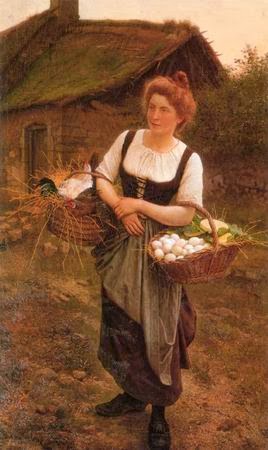
Margaret's father owned a small farm.  She had to feed and put fresh water out for cows and horses and gather the eggs and feed the chickens. 
The Farm Girl by Boulanger Gustave

 She also had the job of helping her mother with the white wash.

In the Crawford home was a large fireplace at one end with a low ceiling.  The soot from the fireplace made the walls dirty.  

Source: http://www.marariley.net/celtic/images/farmhouse1788.jpg


Margaret and her mother had the job of painting the walls to make the home clean and comfortable.  They used white clay or chalk found in nearby hills and mixed it with water to create the paint or white wash.

To get a better idea of what they did, here's a short video showing how whitewashing was done.


In all my research of white washing, I learned that it was time-consuming.  I'm fairly certain this was not a weekly chore.  Especially since it took 3 to 4 days to dry and cure.

One day Margaret and her mother had just finished this chore and were admiring the snow-white walls.  They received a knock on the door.


They didn't recognize the man, and thought he was a beggar.  First he looked at Margaret, then he looked at her mother, then he looked at the walls.  After gazing steadily at Margaret, he walked up to the fireplace and picked up a piece of charcoal. 


Then he did something that shocked the mother and daughter.  He began to write on the wall!

He didn't draw pictures like these kids.


He wrote words.  He filled the entire wall with his words .  When he finished, he silently left their home.  He never said a word.

At first, when Margaret looked at the writing, it seemed to be in a strange language.  Eventually she was able to make out the words.  This is what it said:

Margaret was going to be visited by a young man who was teaching a new and strange religion.  The young man was from the new world and had crossed many waters to teach her this religion.  She would accept the new religion and some of her family would accept it, but they would suffer persecution by joining it.  
The young man was of their own nationality, and would return to his home.  Then he would come again to her land and take her as his wife across the many waters, and there in the new world they would build a home and have a great posterity.

After the family read this, they laughed and made fun of it calling it a fairy tale--except Margaret. She was deeply impressed.  They all wondered how someone could come from the new world but be of their nationality, yet that is exactly what happened. 

 In Feb. 1844, Margaret's mother died.  In the fall of 1844, the Mormon missionaries came to Lanarkshire.  
They probably didn't look like these LDS missionaries currently serving in Scotland and Ireland.
Source: http://ashleemission.blogspot.com/2012/07/headed-to-scotlandireland-real.html

One of those missionaries was James Houston.  

First Margaret's father was baptized on 1 December 1844.  Her sister Christina was baptized the following March, next her brothers James and John in May.  
Margaret was baptized into the Church of Jesus Christ of Latter-day Saints on 26 July 1845 by James Houston.    They were married on 25 Aug 1845 and he was released from his mission on 31 Aug 1845.  

Note: LDS missionaries can no longer marry while serving as a full-time missionary.

James Houston went back to get his wife and on 3 September 1845 they set sail for Nauvoo, Illinois.   She was 20 years old.

James Houston is recorded as saying,

"I received her from the Lord and hold her at his disposal."

Margaret Crawford Houston
Note: To read how James Houston came to be a missionary in his own land, click here.